

Greek translation: Ελληνικά → https://contogeorgis.gr/vivliokritiki-giorgos-kontogiorgis-i-dimokratia-os-eleftheria-ioan-horga/
Democracy, like many other political concepts – freedom, right, property, power, representation, nation, economic system, global system – is poorly or insufficiently defined. They are the result of mutations brought about by modernity, which, instead of being, as it should have been, a phase of anthropocentric evolution, this modernity, with all its conceptual burden, has turned into a model ideology in the global world and a standard of scientific truth.
One of the significant consequences of this evolution was that modernity, in all its conceptual breadth, as a product of reflection, attributed to itself universal qualities as the essence of the evolution towards the peak that humanity has reached. Modernity, in all its philosophical dimensions, has neglected to create general gnoseological categories or milestones to evaluate the natural socio-political evolution, both past and present or future.
From this perspective, the significant error of modernity must be attributed to this belief in the certainty of its global superiority, on the one hand, about the history and, on the other hand, concerning the biological anthropocentric maturity of humanity, which must be said, it had been the one that drove away preceding despotisms.
Returning to democracy, a concept that is crucialy deemed by modernity, it must be noted that it was first experimented with in the Hellenistic world, and modernity adopted it. However, modernity failed to create the necessary conditions for its evolution to the changes in anthropocentric society, leading to a situation where not only did democratic progress stagnate, but it even regressed.
Given these facts, Professor George Contogeorgis, through the book he provides us, aims to reconstruct the nature of democracy in general, with its central concept of freedom, starting from its origin in what he calls the Hellenic cosmosystemic gnoseology. In his opinion, this concept represents a new interpretation of the evolution of the social phenomenon 1.
The concept of cosmosystem defines a set of societies with common fundamental parameters, namely institutional, ideological, and value system determinants, with distinct components of freedom or non-freedom. In its entity, this set of societies examined within the Greek Cosmosystem moves in historical terms of internal self-sufficiency and evolutionary cohesion.
Submitting cosmohistory to the test of cosmosystemic time introduces us to the issue of social biology, that is, to the phases that the social man is destined to go through from the moment he forms himself, for example, in terms of freedom. A demonstrative example in this regard is the Greek world since it formed for the first time in cosmohistory the “alter ego” of the despotic cosmosystem (which prevailed until the 19th century), namely the anthropocentric cosmosystem (societies in freedom) with which it went through all the phases of its evolutionary biology until it led to the transition from the small scale of the city-state to the large scale of the nation-state.
This fact differentiates the Greek anthropocentric paradigm from that of modernity (on a large scale). The latter has little historical depth and thus experiences a very early/primary stage of anthropocentric evolution. We thus present the paradox that is transitioning from the phase of the small to that of the large scale from an anthropocentric perspective: it returned to a starting point of zero.
This contradiction led the modernity of the Enlightenment century to make two major breaks with the Greek past with significant implications in the scientific domain. One of these breaks concerns concepts: it took up the concepts of the classical period (i.e., democracy). It changed its content to define phenomena from the pre-classical period similar to those experienced by its era (i.e., monarchy). The other rupture concerns anthropocentric biology: it shifted the essentially ecumenical phase and its counterpart, the cosmopolis, represented by Byzantium, from the Hellenic anthropocentric continuity and introduced as a bridge between “antiquity” and “modernity” – two anthropocentric phases – the feudal Middle Ages.
Thus, on the one hand, it excluded the possibility of comparison with the anthropocentric past/ with evolutionary biology/ and, on the other hand, it excluded the perspective of discerning its evolution in the future.
It so happens that modernity shows that it passed directly from its birth, from despotism to the final anthropocentric/democratic phase. For this reason, there is no more room for further development. Thus, anyone who questions the current system can choose the authoritarian regime. Worst of all, this limited the possibility of comparison to only morphological differences between modern countries.
What does this mean for the social sciences? Let us take the example of constitutional law. It enters directly into the axiomatic assurance that its political system (the elective monarchy) is both representative and democratic and, after analysing it in its prominent institutions, proceeds to its typology based on the internal arrangements of the narrow core of supreme power: presidential, parliamentary, etc.; the same goes for political science, sociology, the economic system, the international relations, etc.
Cosmosystemic gnoseology liberates modern «science» from stagnation and introversion, thus addressing the presuppositions of genuine science: the conceptualisation and typology of phenomena, biology (the stages of evolution), parameters (generative reasons), and adequate methodology that demonstrates how the conclusions of cosmosystemic gnoseology can inspire a universal science which will enable modernity to know where it comes from, what stage it is at, and where it is going. It also points out that even the most imaginative god would have failed if attempting to merge these three political systems (elective monarchy experienced by modernity, representation, and democracy) into one.
On the other hand, constitutional law inspired by cosmosystemic gnoseology reflects on the nature, values/goals, institutional and factual conditions of each of these three political systems. It introduces the comparison into the field of cosmosystemic typology (rather than mere synchronicity) along with their biological time. It makes similar observations about economic systems, the first of which, in terms of time, is that of modernity.
The phase of state-centrism experienced by modernity is not unique. It is followed by the ecumenical phase, where the State becomes the cosmopolis. The cosmopolis is neither an empire nor an autocratic theocracy, but rather another type of State belonging to the post-state-centric phase of the anthropocentric cosmosystem. Though currently unfamiliar to our era, it is of great interest to science and for a global reflection on the future of the modern world.
The importance of this scientific approach will be explained through an example. Suppose we admit that the political (and economic) system is one and unique and not subject to evolution by virtue under a particular natural biological order. In that case, the hegemony conquered by the international markets (economic ownership) will continue, and the reversal of the balance of power in favour of the society of citizens is not reversible. Otherwise, we must cancel the so-called “globalisation,” which is also impossible.
Cosmosystemic gnoseology teaches that economic ownership dominates because it controls the economic system and, through an intermediary, the political system. In contrast, society can only take over hegemony by entering the political system. For this, there is only one way: to achieve a revolution in the field of concepts, to realise that the political system in which we live is only an elective monarchy and that it has before it as an alternative solution neither the authoritarian regime nor the demonstrations in the street but the transition to representation and beyond to democracy.
Suppose the society of citizens enters into the political system as an institutional partner., In that case, it will decide on the rules governing the economic system, the redistribution of economic products, the rules governing technology, etc.
In short, society is a harmonious organism. If one of its members develops excessively (like the economy and technology in our time), the others follow to maintain the harmony of the whole. Modern science claims that the values and institutions in which contemporary society has settled will remain as they were formed in the 18th century when societies struggled to transcend feudalism and enter into primary anthropocentrism as economic ownership conquered the future and imposed its hegemony.
One last point remains: cosmosystemic gnoseology does not deploy its argument regarding ethics, metaphysics or deontology. It moves over time by providing evidence to explain the nature of phenomena, how and under what conditions the transition from elective monarchy to representation and democracy becomes inevitable, what factors impose it, etc.; likewise concerning the transition from state-centrism to the post-state-centric or ecumenical phase or from the small scale of the city to the large scale of the nation state.
In his book La Démocratie comme Liberté (Democracy as Freedom), George Contogeorgis precisely applies the science emanating from cosmosystemic gnoseology. it is an entirely new science that offers us the tools to understand the past, the present and, obviously, the future. The conditions of the genesis and development of politéia (socio-economic and political systems) are highlighted, the nature of each of them, the logic of the transition from elective monarchy to representation and democracy, their purpose, which is the cumulative propagation of freedom, from the individual to the social and in politics, the distinction between freedom and right, politics as a phenomenon and its structure as force, as power or as freedom, the relationship between political system and State, then the career of these States in the ecumene, within the State of Cosmopolis.
As an example, it can be mentioned that despite what modern thought claims, cosmosystemic gnoseology teaches that the city system and democracy did not end in the 4th century BC. However, they advanced until the 19th century in the Greek world (often beyond) and even from the 5th century, our era without slavery but with the extension of the democratic principle to the economic system.
The first part of Contogeorgis’s work is devoted to exposing these characteristics. It aims to define politics’ relationships with property, freedom, equality, justice, power, and beyond, and ultimately, to understand how democracy became the highest stage of the anthropocentric promise.
It results in a complete reconsideration of the formalisations carried out by the social sciences. For example, in constitutional law, the political system of elective monarchy is both representative and democratic: its typology is based on arrangements closely delimited by legitimate power (presidential, parliamentary, prime ministerial, etc.). These classifications prevent a mode of thought that allows for the Greek cosmosystem’s perspective on the nature, purpose, and values of all political systems identified by constitutional law. It is an approach that is not without consequence since it statically treats our time as if it were not destined to evolve in the realm of values, economics, social, and politics.
The second part aims to understand better the conditions of the birth and trajectory of monarchy, representation, and democracy. The city’s small scale where these phenomena first appear is often considered disqualifying of their heuristic value. On the contrary, this scale is a resource for analysing the resilience of the Hellenic cosmosystem over two and a half millennia, up to the threshold of the 20th century (and not just the two centuries of classical antiquity). The confrontation with the Byzantine phase of the Roman cosmopolis, and then with that of Ottoman domination, demonstrates the dynamic of Greek anthropocentrism even in its state-centric period.
La Démocratie comme Liberté (Democracy as Freedom) abounds with a large number of confrontations aiming to support the thesis that modernity, in the transition from city-state to nation-state, is only the sectoral reproduction of primary elective monarchy, the prelude to the classical period of the Greek cosmosystem in an unfinished march towards democracy.
Therefore, this leads to a significant agenda for our time. It sets forth the conditions for a transition towards a democracy where freedom as non-domination would be the primary focus. It renders the most recent arrangements, such as “participatory democracy” and other circumstantial arrangements, insignificant.
In the book’s last chapter, the perspective and the conditions of the transition towards democracy in the future are examined, as well as what should be built in place of the physical ground of the Pnyx on the ground of communication technology.
Contogeorgis concludes that democracy in the future will be built on the terrain of communication technologies rather than on the physical ground, as in the city’s small scale. Taking into account recent developments, he places its necessity in the fact that restoring a new balance between the society of citizens and economic ownership (in the form of the international markets) has been overturned.
As a result, by reading the book of Contogeorgis, we gain a new perspective on the limits/frontiers of democracy that modernity has brought forth, which, alongside today’s rapidly changing societal transformations and technological advancements, tend to shift, creating new boundaries.
Ioan HORGA
PhD, Associate Professor, University of Oradea. E-mail: ioanhorga56@gmail.com
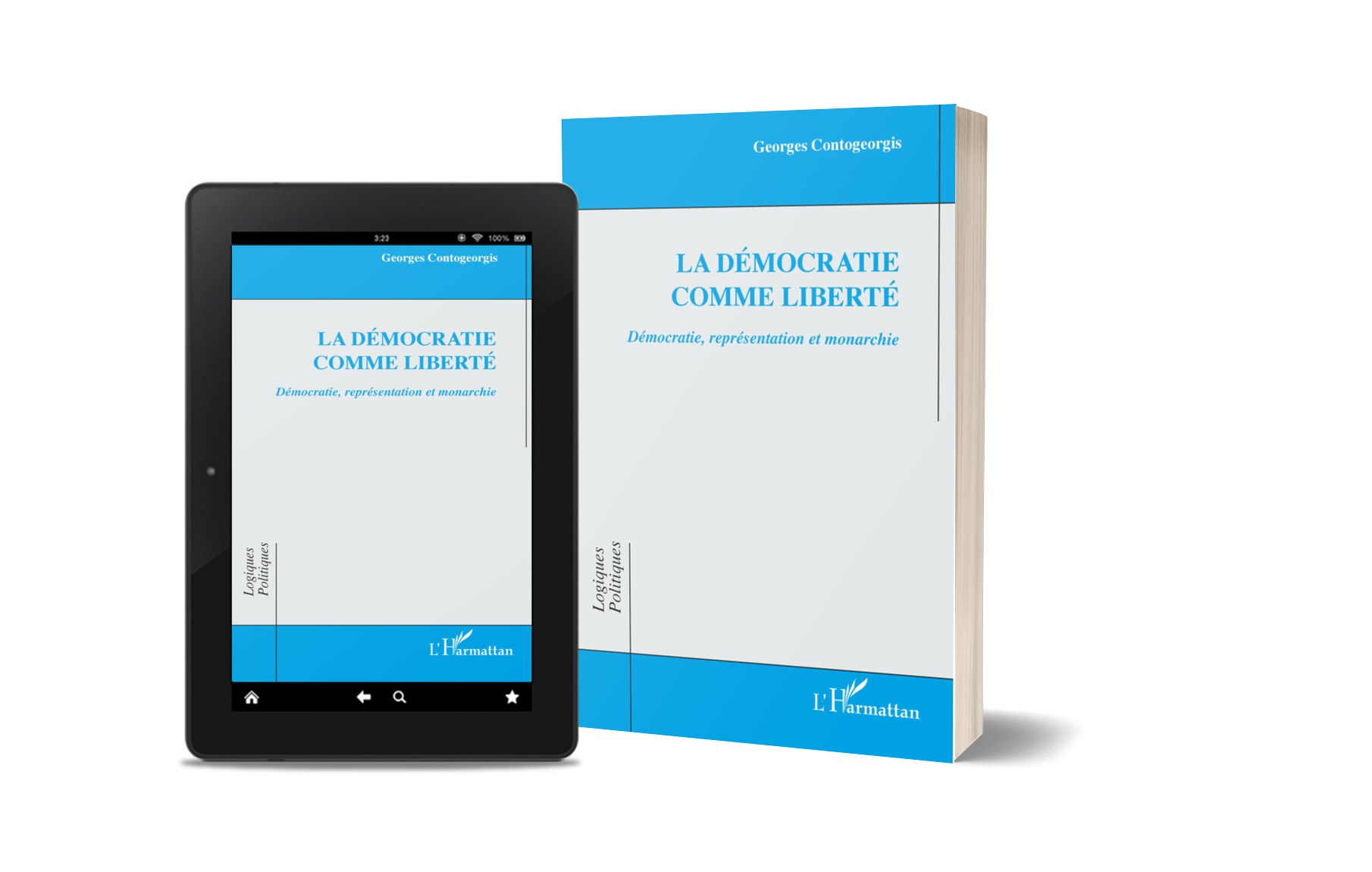
Review of: George Contogeorgis, La Démocratie comme Liberté. Démocratie, représentation et monarchie, Paris, L’Harmattan, 2023, 370p. ISBN: 978-2-14-028654-4
Eurolimes, 33/2023 — https://www.ceeol.com/search/article-detail?id=1301129
- George Contogeorgis, A Cosmosystemic Approach of History: What is at Stake in Social and Political Sciences, in 6 volumes, Athene, Sideris (2006-2021) vol. A. The Greek Cosmosystem. The state-centric period of the city (598p); vol. B The Greek Cosmosystem. The period of ecumenical construction (4thBC-4thAD century (817p); vol. C The Greek Cosmosystem. The Byzantine period of the ecumene (4th AD-15th century): Rome as a Greek trust (569p); vol. D The Greek Cosmosystem. The Byzantine period of the ecumene (4th AD-15th century): Ecumenical integration and the emergence of Modernity (911p); vol. E The Greek Cosmosystem. The Byzantine ecumenical cosmopolis, the European Middle Age, and the modern world. From Greek on the European road to Modernity (500p); vol. F The Greek Cosmosystem. The Byzantineecumenical cosmopolis, the European Middle Age and Modernity. The epistemology of Modernity juxtaposed to cosmosystemic gnoseology (552p) ↩
- Διατηρείται το δικαίωμα αναδημοσιεύσης του παρόντος άρθρου σε οποιοδήποτε μέσο, με απαραίτητη προϋπόθεση να αναγράφεται η παρούσα ιστοσελίδα και ο συγγραφέας ως πηγή. -